Butt Size: The Average, a Size Chart, and How to Measure Yours
The average butt — measured around the fullest part of your glutes — is about 43 inches (110 cm) for adult women in the US, and the middle half of women measure between roughly 39 and 46.5 inches (99–118 cm), according to the CDC’s newest body-measurement survey. So a 39-inch butt is on the smaller side of normal, and a 45-inch butt is above average but completely common.
Your number reflects your frame, your body fat and where you store it, with muscle sitting on top — and the muscle is the part you can build. Below: a size chart of real women, how to measure in the right spot, a quick checker for your number, and what actually changes it.
What Is the Average Butt Size for Women?
When people talk about butt size, they mean your hip measurement taken around the fullest part of your buttocks. That’s where the CDC measures it in its national health survey — at the point where the buttocks stick out furthest when seen from the side (NHANES Anthropometry Procedures Manual). Because trained staff took every measurement on a large national sample, rather than people reporting their own numbers, it’s a reliable real-world comparison.
In the latest survey, run from August 2021 to August 2023, the CDC measured 3,098 women aged 20 and older (pregnant women excluded). The average was 109.8 cm (about 43.2 inches), and the median — the woman exactly in the middle — measured 106.8 cm (about 42 inches) (CDC, Vital and Health Statistics Series 3, No. 50, Table 14).
| Percentile | Butt size (cm) | Butt size (inches) | What it means |
|---|---|---|---|
| 5th | 89.7 | 35.3 | 1 in 20 women measure smaller |
| 10th | 92.9 | 36.6 | 1 in 10 women measure smaller |
| 25th | 98.6 | 38.8 | 1 in 4 women measure smaller |
| 50th (median) | 106.8 | 42.0 | Half of women measure smaller |
| Average | 109.8 | 43.2 | Pulled up a little by the largest measurements |
| 75th | 118.1 | 46.5 | 3 in 4 women measure smaller |
| 90th | 131.5 | 51.8 | 9 in 10 women measure smaller |
| 95th | 138.4 | 54.5 | 19 in 20 women measure smaller |
By age, the average runs from 107.0 cm (42.1 inches) in your 20s to about 111 cm (just under 44 inches) through your 30s, 40s and 50s, then edges down after 60.
Three things to keep in mind. This is US data. It measures everything at that line — bone, fat and muscle together. And it’s an average of real women, not a target anyone is supposed to hit.
How to Measure Your Butt Size
The CDC measures at the point where your buttocks stick out furthest from the side, with the tape level and snug over thin clothing. Do the same and your number compares fairly with the chart:
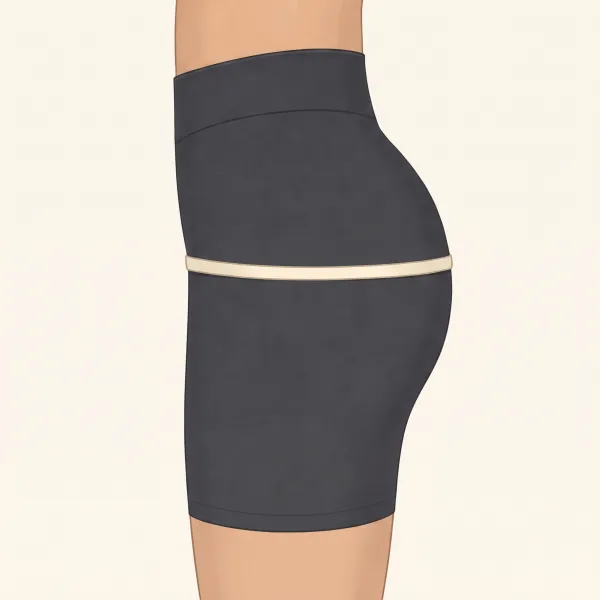
Find the fullest point from the side
Use a mirror: it is where your glutes stick out furthest, usually around the middle of the glutes.
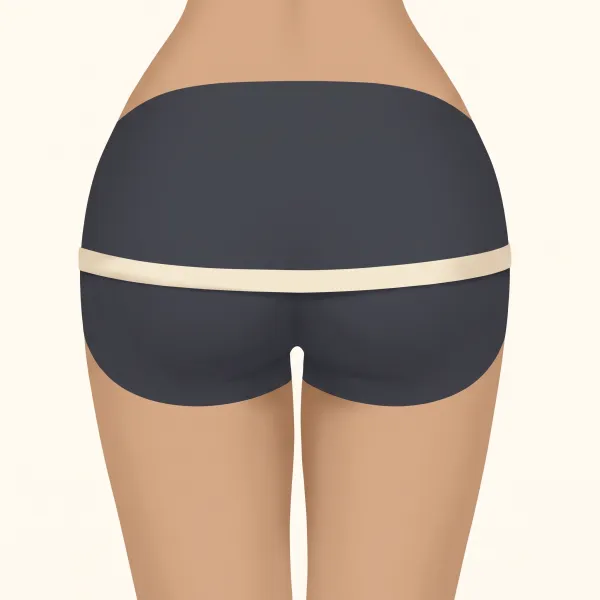
Keep the tape level all the way round
Feet together, glutes relaxed. Snug, not tight — the tape should not dent the skin.
- Use a soft tape measure, over bare skin or thin, fitted clothing.
- Stand straight with your feet together and your glutes relaxed — no clenching.
- Find the fullest point from the side. Use a mirror: it’s where your glutes stick out furthest.
- Wrap the tape around there, level with the floor all the way round.
- Keep it snug, not tight — it shouldn’t dent your skin.
- Measure twice and use the average. If you’re tracking it, measure at the same time of day each time.
Most clothing size charts call this your hip measurement, though some brands measure the hips and the butt separately — so always size a garment against that brand’s own chart, not this one. Add your bust, waist and high hip and the body type calculator will give you your body shape.
Is My Butt Big? Check Your Number
Put your measurement in and see where it sits among real women:
Measured around the fullest part of your glutes, tape level with the floor.
About the 50th percentile
Average
Bigger than about 50% of US women 20 and older, and smaller than about 50%.
Your frame and height change what a number looks like — compare your waist-to-hip ratio in the female body visualizer. Private: nothing you enter leaves this page.
Are 39-inch glutes big? No — 39 inches (99 cm) sits around the 26th percentile. About 1 in 4 women measure smaller, so it’s on the smaller side of normal.
Is a 45-inch bum big? It’s above average: 45 inches (114 cm) sits around the 67th percentile, so it’s bigger than about two-thirds of women — and still very common.
“Big” is also relative to your frame. A 42-inch butt on someone who’s 5’0” looks very different from the same number on someone who’s 5’10”, which is why the contrast between your waist and your hips often says more than the hip number alone. No percentile is a problem in itself, either. The body measurements tied to health risk are your waist and your waist-to-hip ratio, not your hips on their own (WHO expert consultation on waist circumference and waist–hip ratio).
Why Is My Butt Big (or Small)?
Four things decide the number on the tape:
- Your bone structure. The width of your pelvis sets the base of the measurement, and it doesn’t change (Healthline).
- Where you store fat. Estrogen tends to favour fat storage on the butt and hips; after menopause, as estrogen drops, fat shifts toward the midsection (Healthline).
- Your body weight. Gaining or losing weight changes the hip measurement, usually faster than training does.
- Your muscle. The gluteus maximus is the largest of your three glute muscles and the one closest to the surface (Cleveland Clinic). It’s the trainable part of the measurement.
Size and shape are different things, too. Two women with the same 42-inch measurement can have a round, heart, square or V-shaped butt — the butt shapes guide covers all six, and the glute shape quiz tells you which is yours in four questions.
Small Glutes? What Actually Makes Them Bigger
The part of your butt size you can add to is muscle. Build the glute max for size and projection, and the glute medius for the curve at the upper-outer corner.
Four lifts cover it: a hip thrust, a Romanian deadlift, a Bulgarian split squat or step-up, and an abduction like the seated abduction machine. Do 3–4 sets of each, two to three sessions a week — training a muscle at least twice a week grows it better than once (Schoenfeld, Ogborn and Krieger, 2016). Mixing lifts that load the glutes squeezed and stretched helps too; I cover that in shortened vs lengthened glute exercises.
Two things decide whether the tape moves at all:
- Progressive overload. Add weight or reps over time, not the same easy session forever.
- Eating enough. Building muscle takes enough protein and enough total food. Train hard in a big calorie deficit and your measurement can shrink even while your glutes get stronger.
Be patient with the tape. Muscle grows slowly, so measure every week or two under the same conditions, judge the trend rather than any single reading, and take side-view photos too — they show changes in shape that a tape measure misses. Here’s how long it takes to grow glutes, and how I track it. If you’re hoping for something faster, here’s what can change by tomorrow morning and what takes months. Want a structured place to start? Try the 30-day glute challenge, or the beginner glute program if you’ve never lifted.
Want this turned into a routine? Join the waitlist — the Build The Shelf app builds your glute routine around your week, logs your sets so you keep progressing, and keeps private side-by-side progress photos that show the change a tape measure is too slow to catch.
What Is the Ideal Buttock Size?
There isn’t an ideal number in inches. The research on preference measures ratios, not tape sizes.
In a 2017 study, 1,032 people from more than 40 countries adjusted a model’s buttocks on screen to what they found ideal. The most common choice, picked by 39%, was a waist-to-hip ratio of 0.7 — and the preferred size varied by region and ethnicity (Broer et al., 2017). In other words, it’s the contrast with the waist people respond to, which is why the same hip number can look so different on two bodies.
That’s an average preference, not a standard you owe anyone. I went through the research in more detail in what the most attractive butt shape actually is.
What Are Large Buttocks Called?
- Steatopygia is the medical term for a large build-up of fat on the buttocks (Merriam-Webster). It’s a clinical word with a painful history, tied up with the 19th-century exhibition and objectification of African women, so it isn’t a casual description.
- Callipygian means having well-shaped buttocks, and it’s a compliment. It comes from the Greek statue Aphrodite Kallipygos (Dictionary.com).
- Everyday words like curvy, thick or “bubble butt” describe appearance, not a category.
Whatever your number, the tape only tells you where you are, not where you have to be. The Build The Shelf app is being built to help you train the part you can change and see it happen — join the waitlist to get it first.