A-Shaped Butt: Causes and How to Train It
An A-shaped butt (also called pear or triangle) means your glutes look narrow at the top and widest down low, where your butt meets your outer thighs. It is not a defect and it is not a medical category. It comes from fat sitting low on the hips and thighs, a wider lower-hip structure, and an underbuilt upper glute max and glute medius. You change how it looks by adding muscle up high and out to the sides, not by trying to shrink the bottom: heavy hip thrusts, abduction work, cable kickbacks and step-ups, two to three sessions a week. Below is the self-check, the causes, the exercises with sets and reps, and a 2–3 day plan.
Quick Answer: How Do You Train an A-Shaped Butt?
If you read nothing else, this is the plan.
- Build the upper glute max for projection and the glute medius for the side curve. That is what fills in the narrow top and squares off the triangle — the full list is in my upper glute exercises guide. The glute max is the size-and-projection muscle; the glute medius is the one that rounds the upper-outer corner.
- Do not try to fix an A-shape by shrinking your lower hips. You add up top instead. Losing fat off your hips without muscle underneath just gives you a smaller triangle.
- Cover the four movement patterns every week: a thrust, a squat or lunge, a hinge or pull, and an abduction. One of each is enough.
- If you only want two exercises: a heavy hip thrust and a seated abduction.
- Two to three glute sessions a week, progressive overload, and eating enough to build muscle. None of those three is optional.
If you would rather have this sized to your actual week and equipment, that is what I am building the app for — join the waitlist and it will do the layout for you. Everything else on this page works with a notebook.
What Is an A-Shaped Butt? (And Do You Have One?)
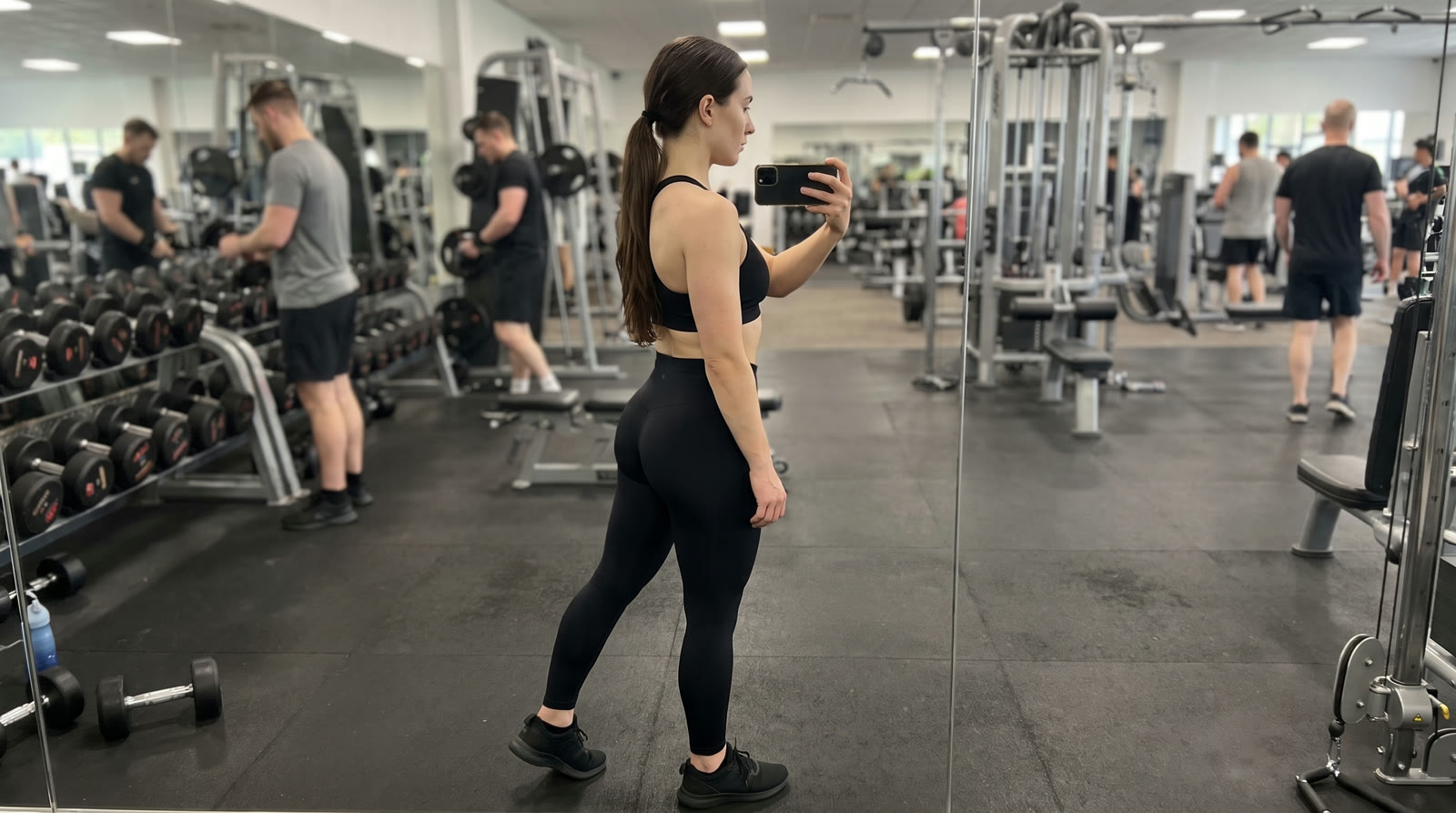
An A-shaped butt is narrower across the top of the glutes, with the fullness sitting low and out to the sides, so the widest point is near the hip-and-outer-thigh line. From behind it reads as a triangle, or a capital A. People also call it a pear-shaped butt, a triangle bum, A-shape glutes, or bottom-heavy glutes. Same thing.
The 30-second mirror check. Back view, relaxed, in fitted shorts. Find your widest point:
- At the top of your hips, tapering down — that is an inverted V, the opposite pattern.
- Level all the way down, a straight line from hip to thigh — that is a square butt.
- Low, near your outer thighs, with the top noticeably narrower — that is an A-shape. This page is for you.
If the mirror check leaves you between two, the glute shape quiz adds two training questions to break the tie.
One thing to settle, because the magazines contradict each other on it: some of them lump the A-shape in with the heart-shaped butt. The difference is the taper. A heart shape is full through the lower glutes and tapers up toward a narrow waist, so it looks full and curvy. An A-shape keeps widening downward toward the thighs, so the fullness sits at the bottom of the triangle rather than on the glutes themselves. They are neighbours, and they are trained differently.
These are appearance words, not diagnoses. No doctor has ever written “A-shaped” in a chart. They are useful for one thing only — figuring out which part of the glute to build — and that is how I use them across the butt shapes guide.
Is an A-Shaped Butt Normal? (And the “Four Types” Question)
Yes. Bottom-heavy fat distribution is one of the most common patterns in women, and it is driven by hormones and genetics, not by anything you did or failed to do. If your body prefers to store fat at the lower hips and thighs, the base of the triangle is the result. There is nothing wrong with you.
On the “four types of female buttocks” question: the four usually named are square (or H), round (or O), heart (or A), and inverted V. The count changes from article to article — some say four, some five, some seven — because nobody owns the definitions. They are shape-chart shorthand, not anatomy.
The anatomy is the same on everyone. A buttock is three muscles — the gluteus maximus, medius, and minimus — covered by a fat layer that sits differently on every body. Per the Cleveland Clinic’s overview of the glutes, those muscles exist to extend the hip, stabilise the pelvis, and hold you upright. They were not put there to fit a chart category.
So there is no best glute shape. There is the shape you have, and how much muscle you have built onto it. That second part is the whole game.
What Causes an A-Shaped (Pear) Butt?
Three things, and it matters which is which, because only some of them move.
Fat distribution. Fat stored preferentially in the lower hips, outer thighs, and the saddlebag area makes the base of the triangle wide. This is hormonal and genetic, and it is the thing most people blame first.
Skeletal structure. A wider lower pelvis, and where your femurs sit in it, creates width down low that you did not train and cannot train away. This is bone. It is also usually less of the picture than people assume.
Muscle — the part nobody mentions. An underdeveloped upper glute max means there is no fullness where the glute meets the lower back, so the top of the shape stays narrow. A weak glute medius means no side curve at the hip. Take those two away and almost any pelvis reads as a triangle.
Training history feeds the third one. If your lower-body work has been squats and more squats, your glute max has been growing — squats build it about as well as hip thrusts — but your glute medius has had almost no direct work. In a nine-week trial in beginners, neither squats nor hip thrusts grew the glute medius much (Plotkin et al., 2023), and that upper-outer region is exactly what an A-shape is missing. Months of squats with no change up top is not a sign your shape is fixed. It is a sign the exercise selection was missing abduction.
Which of the three can you move? Muscle, a lot. Fat distribution, somewhat, and slowly. Bone, not at all.
Can You Change an A-Shaped Butt?
Yes — meaningfully — and I want to be exact about what “change” means so you do not quit in week three.
You change how the shape reads by adding muscle to the upper and outer glutes. The triangle starts to look fuller and rounder because the top catches up to the bottom, not because the bottom shrinks. That is the correct direction, and it is the one most pages on this topic get backwards.
What you cannot do is relocate fat with an exercise. No “hip dip” move, no “saddlebag” burner, no fire-hydrant circuit spot-reduces fat from the spot it works. Your glutes are not Play-Doh. Fat comes off the whole body on the body’s own schedule, and for a lot of women the lower hips are last.
What realistically changes: projection off the lower back, side curve at the hip, firmness, and how leggings sit.
What does not change: pelvis width, muscle insertions, and where your body prefers to store fat.
If you are also losing fat, do it slowly — a small deficit, not a crash — and keep protein and training volume up. Cut hard and you lose the muscle you are trying to build, which leaves you with the same triangle, smaller.
Best Exercises for an A-Shaped Butt
This is the prescription. Each entry says which region it targets, because that is the point — the A-shape is missing muscle in two specific places, and the list is built around them.
Hip thrust — 3–4 sets of 6–10, heavy. Your main glute-max builder: it works the upper and lower glute max about equally (Selkowitz, Beneck and Powers, 2016), and it’s easy to load heavy and keep progressing. Use the barbell hip thrust in a gym, the dumbbell hip thrust at home, or the machine hip thrust if your gym has one. Region: whole glute max.
Seated or banded abduction — 2–3 sets of 15–20, slow, with a one-second hold at the top. This builds the glute medius side curve that squares off the narrow top. Do not rush these; the hold is the exercise. Region: glute medius. Full breakdown in the glute accessory guide.
Cable kickback — 3 sets of 12–15 per side, with the working leg kicking back and slightly out to the side. That adds abduction, the movement that favours the upper glute max over the lower. It’s a good exercise for learning to feel the upper glute, which most people with an A-shape have never done. Region: upper glute max.
Step-up on a knee-height box — 3 sets of 8–10 per leg. Loads the glute at long muscle lengths without turning into a quad session, as long as you keep the box high and drive through the heel. Region: whole glute max, with the lengthened-position emphasis that squats miss.
Romanian deadlift — 3 sets of 8–10. The hinge pattern for the glute-hamstring tie-in, again in the lengthened position. Region: lower and mid glute max, hamstrings.
Glute-biased back extension or frog pump — 2 sets of 15–20 as a finisher. Shortened-position finishers after the heavy lifts are done. Both put your hips in outward rotation — toes turned out on the back extension, soles together on the frog pump — the same idea as abduction work, though neither tweak has been measured on its own. Region: glute max. Both are covered in the accessory guide.
The progression rule. Add five pounds or one rep per set per week on the hip thrust and the Romanian deadlift before you add a single new exercise. Progress is the stimulus. Variety is not.
What to demote: high-rep bodyweight squat circuits, and every “secret glute finisher” that shows up in your feed at 11:47 p.m. They are not useless, they are just not what an A-shape needs.
Sample A-Shape Glute Workout (2–3 Days a Week)
Here is the list turned into a week you can copy. Sessions are 35–45 minutes; leave at least 48 hours between glute days.
Day 1 — upper glute + abduction
| Exercise | Sets × reps |
|---|---|
| Barbell or dumbbell hip thrust | 4 × 8 |
| Step-up | 3 × 10 per leg |
| Seated abduction | 3 × 20 |
| Glute-biased back extension | 2 × 15 |
Day 2 — hinge + side glute
| Exercise | Sets × reps |
|---|---|
| Romanian deadlift | 3 × 8 |
| Cable kickback | 3 × 12 per side |
| Bulgarian split squat | 3 × 8 per leg |
| Banded abduction | 2 × 20 |
Optional Day 3 — 20 minutes
| Exercise | Sets × reps |
|---|---|
| Machine hip thrust | 3 × 10 |
| Frog pump | 2 × 25 |
| Seated abduction | 2 × 20 |
The 20-minute day exists for the week your schedule falls apart. Two good days beats three rushed ones.
Log your sets and weights. If the numbers are not moving in three weeks, the shape will not either — and the log is how you know which one to fix.
Want this built for your week? The Beginner Glute Program lays out the thrust, hinge, and abduction work in order — or join the Build The Shelf waitlist and the app will size it to your days, time, and equipment.
How Long Before an A-Shape Starts Looking Rounder?
Honest timeline, so you do not check the mirror on day nine and quit.
- Weeks 1–4: strength climbs, the pump and firmness change, the shape is mostly the same. This is normal and it is working.
- Weeks 8–12: the first visible upper-glute fullness and side curve, if you have been adding load and eating enough.
- 6–12 months: the change that shows up in photos and in how jeans fit.
If you want to see where that goes after a year or two, the female body visualizer shows a body at your height and weight untrained and after each year of glute training.
You need to be eating for it. Building muscle at all takes a small calorie surplus, or at minimum maintenance, plus enough protein — roughly 0.7 to 1 gram per pound of bodyweight per day. Train hard in a big deficit and the plan above just makes you tired.
Take back-view progress photos in the same shorts, same light, every week or two — here’s how long it takes to grow glutes and how to track it. You cannot see slow change day to day, and the side-by-side is the only thing that keeps people going through weeks five to eight. (Keeping those photos private and comparing them over time is one of the things the app does, if you would rather not manage a camera roll.)
A-Shape vs V-Shape vs Square vs Heart: Quick Comparison
If you are not sure you self-diagnosed correctly, check your shape against its neighbours. A wrong guess sends you to the wrong training emphasis.
| Shape | Where the width sits | What’s usually underbuilt | Main training focus |
|---|---|---|---|
| A-shape | Widest low, near the outer thighs; narrow top | Upper glute max, glute medius | Heavy thrusts + abduction to fill the top and sides |
| Inverted V | Widest at the upper hips; tapers down | Lower glute max | Lengthened-position work: RDLs, split squats, step-ups |
| Square / H | Straight line from hip to thigh; no side curve | Glute medius | Abduction first, then thrusts for projection |
| Heart | Full low, tapering to a narrow waist | Usually the least underbuilt | Glute max for projection; keep the curve |
All four respond to the same four movement patterns — thrust, squat/lunge, hinge/pull, abduction. Only the emphasis changes. Pick the row that matches your mirror, follow that page, and give it a full program before you judge it.